

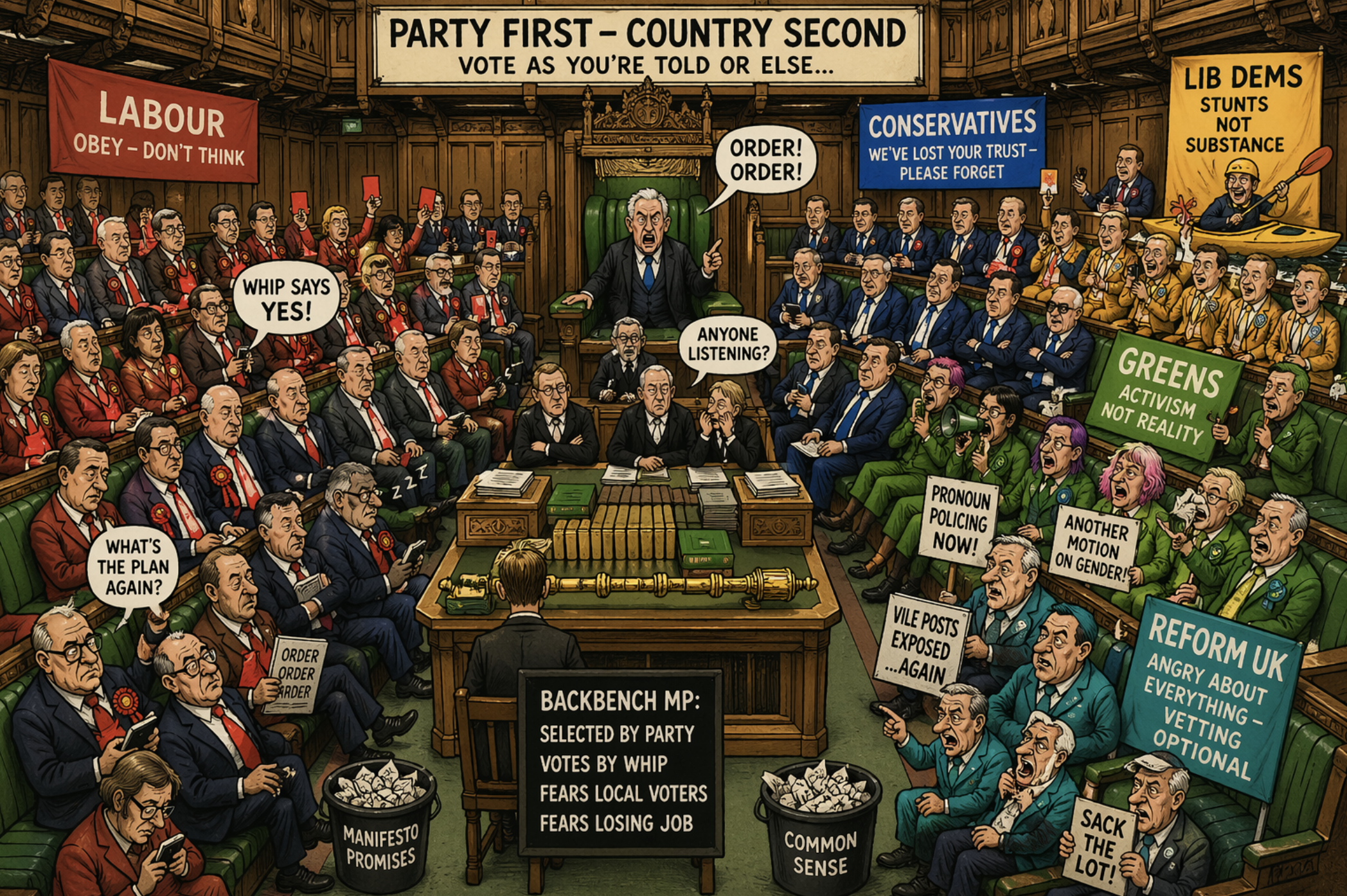
Whatever Labour MPs do about no-hoper Prime Minister Starmer, it was them what put him there in the first place. They sat in his cabinet, nodded along to his nonsensical claims about tax, immigration and the Chagos Islands, and cheered his dull statements in the Commons as if they were hearing Churchill reborn rather than a man who can drain energy from a room in thirty seconds. “KEIR IS MY FRIEND,” said Ed Miliband, one of the ministers now jostling to replace him.
They voted for Labour’s plan to suspend local council elections as well—until Reform came along and took them to court. Only then did the lawyer squatting in No.10 start backing away from his scheme to deny millions their vote.
Labour MPs now mutter darkly to journalists, brief against him anonymously, and whisper that he has “lost authority”. Lost it? He never had much to begin with. What he had was borrowed authority from a parliamentary party too lazy or too timid to think for itself. They wanted a respectable suit after the Corbyn years and chose the first mannequin available. Along with his free spectacles and concert tickets.
The other parties are no better.
The Tories are out of the picture and may stay there for years. After chaos, betrayal and blunder, why would anyone trust them? They promised competent government and gave the nation Boris Johnson’s circus, Liz Truss’s market explosion and Rishi Sunak’s damp managerial shrug. A party that burns down the house cannot complain when voters will not hand back the keys.
The Liberal Democrats remain the joke party of British politics. Plenty of leaflets, by-election tricks, photos on paddleboards, ladders and novelty vehicles, but almost nothing serious to say. They have 70 MPs and yet have added little to the national debate. They exist mainly as a parking bay for people who dislike everybody else.
The Greens are sold as kindly eccentrics who like bicycles and recycling. Nonsense. They are packed with the Corbynite leftovers who fled Labour once their faction lost control. Many of the same people who spent years denying or excusing antisemitism scandals in Labour simply changed badges and carried on. Same politics, same sneering moral vanity, different logo.
And every level of the party the Greens are infested by gender politics. Every committee, every branch, every conference motion, every internal election seems to end in rows about identity jargon, pronouns, disciplinary codes and activist theology. While normal people worry about rent, crime, roads and whether they can get a GP appointment, Green activists are fighting over terminology like medieval monks arguing over angels.
Then there is Reform. It has tapped into real anger about borders, stagnation and elite contempt, and fair enough. But it is also full of Tory retreads, grievance-merchants and a startling number of candidates nobody had properly checked. Repeatedly the media finds vile social media posts, racist comments, fantasies, crank theories, abuse that in many workplaces would mean instant dismissal. One after another they had to be ejected once daylight hit them. That is what happens when a party grows fast and mistakes anybody angry online for public office material.
So what is left for the voter?
Labour: machine politics led by a bore.
Tories: disgraced by failure.
Lib Dems: stunts without substance.
Greens: activist hobbyists and old Corbyn wreckage.
Reform: genuine grievances mixed with alarming baggage.
No wonder people switch off.
The real problem is bigger than any one leader. It is the party system itself. Parties now exist to protect themselves first, country second. MPs are not chosen for wisdom or courage but for obedience, presentability and willingness to repeat nonsense on breakfast television.
Once elected, they become lobby fodder. They troop through division lobbies on command. They defend policies they know are rubbish. They praise leaders they privately despise. They attack opponents one week then copy their ideas the next. If they rebel, promotion dies. If they comply, they may get a junior brief and a chauffeured car.
That is not representation. It is payroll politics.
Back in the eighteenth century, MPs were elected as individuals — the only way they could be elected, because the party machine did not yet exist to do their thinking for them. A man came to Westminster with local standing, a personal reputation, and a mind of his own. He then formed loose alliances with like-minded men — Whigs on one side, Tories on the other — and they chose ministers from among themselves, with one serving as primus inter pares, first among equals. Robert Walpole became Britain’s first Prime Minister after 1721 not through any constitutional design but because George I couldn’t speak English and needed someone to chair Cabinet. Power followed ability and nerve, not the instructions of a party director.
Edmund Burke put the principle plainly to his Bristol constituents in 1774: an MP owes you his judgement, not his obedience. That idea is now a disciplinary offence.
That old world had many faults. It was corrupt, oligarchic, and rotten — sometimes literally, in the case of Old Sarum, a Wiltshire hillside with no inhabitants that returned two MPs until 1832. But even its corruption contained a kind of pluralism. What it never did was reduce the elected representative to a ventriloquist’s dummy mouthing approved lines from the centre.
That is what we have now. And we should be furious about it.
Social media has made things worse. Now everything is nationalised by phone screens. A clip trends in London and decides votes in Carlisle. Candidates matter less than party logos. Serious people are crowded out by slogan-merchants and outrage addicts — and a voting system designed for the age of the parish pump is collapsing under the weight of the age of the feed.
So we need to go back toward voting for the person.
Who are they?
What have they done?
Do they know the area?
Can they think without a script?
Would they defy their party if the party was wrong?
Would you trust them with power?
Those are the questions that matter.
We need easier routes for independents, open local candidate selections, weaker whips, stronger recall powers, and more free votes in Parliament. Let MPs answer to voters, not to party managers and WhatsApp groups in Westminster.
We are told strong parties bring stability. What they actually brought was lockdown hypocrisy, revolving-door prime ministers, tax disasters, suspended election plans, candidate stitch-ups and endless lies recited by obedient mediocrities.
Stable incompetence is nothing to boast about.
Britain does not need more parties, more slogans or more tribal rubbish. It needs better people in Parliament.
Vote for the individual. Ignore the badge. Judge the person. And if enough people do that, Westminster might once again contain representatives instead of trained seals.
I might even stand myself – but not in my London home, Hackney where the Green mayoral candidate is currently 1-10 on.