
Tesla

Tesla plans its first off-grid community

Tesla is planning  to take a 1,400-acre community in Mexico completely off-grid.

The first-of-its-kind energy solution at the Twin Dolphin community in Los Cabos, will see Tesla supply batteries and power management for a private residential community and club, Montage Los Cabos resort and residences, and Twin Dolphin Club.  A similar setup will be implemented next fall in Sonoma County, California.

The initiative at Twin Dolphin will leverage Tesla’s fully integrated solar panels and battery energy storage and software systems to provide reliable renewable energy for the entire community, which developer Ohana claims has received government approvals and is currently underway.

The Tesla project will generate over 20 gigawatt-hours of electricity a year. The project consists of a central ground-mount site spanning over 22 acres, located adjacent to Twin Dolphin’s already existing reverse osmosis and desalination plant that provides potable water to the community. Tesla Powerhub, a data platform to monitor energy use, is incorporated into the project to use real-time and historical data tracking to optimize its energy usage, improve performance, and help inform future decisions.

The new systems will provide all the energy for Twin Dolphin, and also generate clean back-up power for the wider community.  The  system will run completely off-grid if needed, in the event of power outages due to storms or natural disasters. The back-up power supply can also feed into the local power grid as the Baja region of Mexico, which has experienced energy shortages with increased development.

“We are excited to see our vision of being the first off-the-grid community in Cabo coming to life. We are grateful for the partnership and engagement of Tesla and their technologies, which have made this possible. Our larger vision is that other premier master plan community developers will follow our lead and implement similar projects so that collectively we can help preserve our environment,” says Chris Smith, CEO of Ohana Real Estate Investors.

This new solar initiative complements sustainability initiatives at Twin Dolphin, including the preservation of over 40,000 native plants during the development of the property maintained by its water plant, conserving energy through building design that maximizes natural cooling, utilizing locally sourced building materials, implementing tankless water heaters in all buildings and using LED lights throughout the property.…


Read More »
Tesla to build world’s largest battery
Energy

World’s largest battery in 80 days

Tesla is teaming up with French energy company Neoen to build the world’s largest battery within 80 days in South Australia.

The state has been struggling with energy problems, and in an attempt to stabilise the energy Tesla has made a deal to pay A$50m if they fail to deliver the project on time. The grid-scale battery storage could help to even out price spikes, prevent blackouts and improve reliability across the network.

At a conference in Adelaide, Australia Tesla CEO, Elon Musk said the battery will be more than three times the size of the current record holder. It is a lithium ion battery and will be 100 megawatts, compared to the next largest battery, which is 30 megawatts. Tesla estimates the battery could power 30,000 homes. The 129MWh battery, which is paired with a wind farm, is designed to improve the security of electricity supplies across South Australia.

Musk told reporters in Adelaide this month he is confident in the techniques and design of the system, although it will be challenging: “There is certainly some risk, because this will be the largest battery installation in the world by a significant margin. When you make something three times as big, does it still work as well?”.

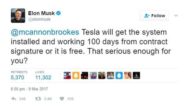
In March Musk made his pledge on Twitter the he could deliver the battery within 100 days of signing the contract or it would be delivered free. Jay Weatherill, the South Australia state’s premier, confirmed the deal, which now is a part of the government’s A$550m energy plan.

“I’m thrilled with the selection of Neoen and Tesla, whose experience and world leadership in energy security and renewables will help South Australia take charge of its energy future,” Weatherill said.

On a related theme, read about the South Africa Power Crisis here.

Read More »

Tesla’s solar tiles may be too costly

The solar roof tile seems set to transform technological necessity into desirable object.   Elon Musk’s launch event last week was a revolutionary moment because it integrated urban house design with solar technology.

Bring it on, if you can, Mr Musk-  but at the right price.

Consumer Reports says Elon Musk needs to price his tiles at no more than $73,500 for the average pitched roof. It calculated how much Tesla’s new solar tiles would have to cost to be competitive with a traditional roof.

Tesla (TSLA, US) has not yet provided specifics about how much the tiles will cost. Chief Executive Elon Musk has said the “beautiful” solar tiles would beat rivals in price, efficiency, and looks.

Instead of solar panels perched on roofs, that are visible from the outside and not exactly an architectural enhancement, homeowners would get a seamless product made with sleek glass that covers a house and powers it too. And the produce will be available in four styles.

Consumer Reports estimated that to cover the roughly 3,000 square feet of roof needed for the average U.S. home size, homeowners would have to shed $16,000 for clay tile, $20,000 for an asphalt roof, and $45,000 for a slate roof.

The magazine calculated $60,000 in added value from 30 years free of electric bills ($2,000 a year is a typical electric bill in states where solar is big, like California, Texas, and North Carolina) and did other calculations to arrive at $73,500 as the price point a Tesla textured or smooth glass solar roof could be considered cost-competitive with a $20,000 asphalt roof.

That competitive price point is lower for Tesla’s Tuscan-style solar tile and higher for its slate-looking solar tile.

Tesla shares were slightly higher Thursday, but are down 21% in the year so far, while the S&P (SPX, US) as gained 2.4%.

This, from news site TechCrunch: & It’s easy to dismiss the aesthetic import of how Tesla’s tiles look, but it’s actually important, and a real consideration for homeowners. The appearance of the tiles, which come in four distinct flavours, is going to be a core consideration for prospective buyers.& More about those & distinct flavours& there is Textured Glass, a metallic looking flat tile; Slate Glass, which is very hard to distinguish from traditional slate; Tuscan Glass, the old, curved Italian-style tile; and Smooth Glass.

In short, you will become a consumer living inside Musk’s vision of the future: an ecosystem that is modern, cool and green. And expensive.…

Read More »
Energy

Top-end batteries for off-grid living


A good off-grid battery can cost you anywhere from $70- $2000 and last between 4-10 years, if you look after it right. And the best buy is NOT a Tesla.

Experienced off-gridders know how crucial it is to have good energy storage capacity, to ensure comfortable living. We’ve gone ahead and broken it down for you, so you don’t have to.


  1. Deep-Cycle Lead-Acid Batteries
    Lifespan: 4-8 years

    Price: $69.99 for a 35Ah 12V battery.  These are probably the best you can get right now, in terms of price vs quality. This is a battery that you can charge to a significant amount and which can provide a steady amount of useable power for extended periods of time. They are designed to be regularly deeply discharged using most of its capacity and can be stacked. Lasting around 20 hours per charged use and 4-8 years, this battery is a low-cost favorite for the outdoor lifestyle.
  2. Sealed Lead-Acid Batteries
    Lifespan: 2-4 years

    Price: $60These beauties use gelled or absorbed electrolytes and although bearing some resemblance to the ones above, there are a few distinct differences between the two. In some ways, the sealed alternatives are better than deep-cycle lead-acid batteries. They require no maintenance other than charging, work well with small solar arrays and can be charged to lower voltages as lower charge rates, don’t leak or suffer terminal corrosion are easily stackable so will take up less space in a battery bank which is a big plus when you’re pushed. They are extremely sensitive, meaning that they can be damaged easily if they are overcharged, and may not even work if they are undercharged. Also, they are similarly as priced as their competition but their life span is only half as long. So that’s a big thumbs down for reliability and being cost effective.
  3. Tesla, Powerwall
    Lifespan: Over 10 years

    Price: $3,000-$3,500Now this battery was designed to power your entire home using renewable battery power, indefinitely. CEO of Telsa, Elon Musk refers to it as changing the “entire energy infrastructure of the world.” and you can watch him unveil it here. Powerwall comes in 10 kWh weekly cycle and 7 kWh daily cycle models. Both are guaranteed for ten years and are sufficient to power most homes during peak evening hours. Multiple batteries may be installed together for homes with greater energy need, up to 90 kWh total for the 10 kWh battery and 63 kWh total for the 7 kWh battery. The only downside is the price. The 7 kWh model is priced at $3000 and the 10 kWh at $3500. So if you can afford to splurge, this is the battery to break the bank!
  4. LG Chem, New Generation System
    Lifespan: Over 10 years

    Price: $2,000. The South Korean company has released a new battery system in Australia which offers
Read More »
Battery company comes to aid of off-grid movement
Energy

Electric Carmaker To Sell Cheap Batteries To Power Homes

Here’s an inconvenient truth – solar power only works during the daytime. People who use it need to store electricity, which means a lot of batteries.

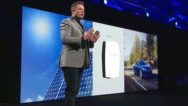
Last night, the electric carmaker Tesla offered to sell some. The company announced it will start selling enormous packs of batteries designed to power homes and businesses.

Tesla founder Elon Musk said this week: “You can actually go – if you want – completely off-grid. You can take your solar panels, charge the battery packs and that’s all you use.”

When JB Straubel was 14, he scraped together 1,500 bucks and bought an old Porsche 944 with a blown out engine. And then he converted it into an electric car. That electric Porsche had a top speed of 110 miles an hour – just not for very long.

“It had, like, 20 miles of range. It was totally impractical,” said Straubel.

Today, Straubel is the co-founder and chief technology officer at Tesla.

“So that kind of cemented it for me that OK, the focus here needs to be on energy storage and batteries to make, you know, this technology something that’s useful to the world.”

Today, Tesla’s cars have a range of more than 260 miles. And JB Straubel’s convinced if his company can make batteries cheap enough, it will be able to sell millions of electric cars. But Straubel says that’s not the only thing a cheap battery could do. He thinks cheap batteries could revolutionize the electric grid.

Think about it. There is no way to store electricity on the grid. If there’s a surge in demand and you run a power company, you have to fire up an extra power plant.

“It’s an entire market for energy transaction that has no inventory and no buffer,” says Straubel. “So every single thing is delivered, you know, instantaneously just in time.”

And that means there’s an enormous amount of waste. So Tesla wants to sell its batteries to consumers, businesses, homeowners – even utilities. But the question is for the homeowner, who has solar panels on the roof – what’s the value proposition?

Before last night’s announcement, one analyst I spoke with expected Tesla’s new home batteries would cost in the neighborhood of $20,000. The real price was much lower.

Elon Musk announced the battery cost would be just $3,500.

These batteries mount to your wall and don’t take up much space. But still figuring out if it makes financial sense to slap a Tesla battery pack up in your garage isn’t simple. You know, most people are not going to go off the grid. And even though it costs electric companies a lot more money to deliver power to you in the middle of a hot summer day than in the middle of a cool night, utilities don’t charge for power that way – usually. In most places, there’s no financial incentive …

Read More »

Batteries not improving, so gadget efficiency is goal

WSJ 5th Oct – There is no Moore’s law for batteries. That is, while the computing power of microchips doubles every 18 months, the capacity of the batteries on which ever more of our gadgets depend exhibits no such exponential growth. In a good year, the capacity of the best batteries in our mobile phones, tablets and notebook computers—and increasingly, in our cars and household gadgets—increases just a few percent.

It turns out that storing energy safely and reliably is hard in a way that miniaturizing circuits is not. A pound of gasoline contains more than 20 times as much energy as a pound of lithium-ion batteries. And then there’s the expense: The battery pack in a Tesla Model S costs approximately $30,000.…

Read More »