

false accounting

Energy

World’s Largest Carbon Capture Facility: Game-Changer or Fossil Fuel Smoke-Screen?

In the race to Net Zero, the construction of the world’s largest carbon capture facility in Texas exposes all the contradictions of the energy industry in one emblematic project.

The importance of the Petra Nova plant cannot be overstated. By burying the CO2, its backers believe they can eliminate the biggest single criticism of fossil fuel consumption. Bloomberg breathlessly reported it would sequester  “1.4 million tonnes” of carbon per year.  This sounds like a lot, and The Guardian report says “The plant will inject 500,000 tons of carbon dioxide into the ground each year.” Whichever,  its success would be a proof of concept for the fossil fuel industry. Hundreds more plants would follow, say the owners, JX Nippon. But a careful look at their figures shows their claims just do not add up.

Positioned as a crucial solution to avert climate catastrophe (if it actually works)  the “$1bn” facility aims to capture and store carbon dioxide emissions from a nearby coal-fired power plant.  Petra Nova began operating in 2016 at the power plant in Texas, and shut down less than four years later after a fire (and following a plunge in oil prices during COVID-19).  It restarted on Sept. 5,  JX Nippon said last month.

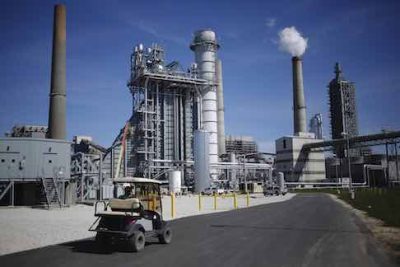
The W.A. Parish Generating Station is a 3.65-gigawatt (3,653 MW), dual-fired power plant located near Thompsons, Texas. The station occupies a 4,664-acre site and consists of two four-unit plants; one natural gas and the other coal (2,697 MW).  With a total installed capacity of 3,653 MW, it is the second largest conventional power station in the US, and supplies about fifteen percent of the energy in the Houston area. Critics argue it was initially responsible for the rolling blackouts of the 2021 Texas power crisis.

As mentioned above, and reported in breathless tones by Bloomberg, the carbon capture plant claims it can bury 1.4 million tonnes a year – but the coal-fired power station emits over 16 million tonnes per year, (assuming it is operating at 70% capacity). And the Gas-fired plant would emit another 3 million tonnes (at 70% capacity). So the claims of 1.4 million tonnes of CO2 per year, which Reuters reports as a target but Bloomberg report as an actuality, is less than 10% of total emissions from the power plant. It would require another $9 billion of investment just to sequester all the CO2 from this plant alone.

With some viewing carbon capture as nothing more than a distraction backed by the fossil fuel industry, the above analysis shows the maths of the Petra Nova project  just dont add up. If it wasnt for the government subsidies the plant would not make anything like enough to pay for itself, and produce a return on investment.

So if the Petra Nova project really is a huge white elephant, then what is it all about really?  Why would some …

Read More »
Company with largest corruption fine in history is caught out again
Energy

Siemens NY power plant false claims

In an echo of the VW emissions scandal, a Siemens power plant paid for entirely with public money was built on the basis of false claims about its energy saving potential.

Siemens claimed it would save Warren County NY at least $1.5m over 5 years. When a former Siemens employee questioned this, he was told he was not a team player.

A fraud investigation by the Warren County sheriff’s office found there was probable cause to charge a top county official with misconduct for his handling of the project, involving a cogeneration plant deal built by Siemens Building Technologies, based in Penn Plaza Manhattan.

Siemens is well known to be morally bankrupt.  A 2008 investigation found Siemens’ culture of corruption extended far beyond the executive suite. As one investigator said  “bribery was Siemens’ business model”. In fact, the company even had a handy accounting euphemism for its bribes: “nützliche Aufwendungen,” or “useful money”.

The Warren County investigation, which began in 2011 and ended earlier this year, determined that County Administrator Paul Dusek could be charged with official misconduct, a misdemeanor, for allegedly misinforming the county Board of Supervisors when he negotiated an energy-performance contract with Siemens in 2004, when he served as the county attorney, according to the sheriff’s department’s investigative file. The contract was tied to the cogeneration plant at the Westmount Healthcare Facility. As the county attorney at the time, Dusek was responsible for reviewing the contract and offering advice to the county board of supervisors on the agreement with Siemens.

However, Siemens intentionally overstated energy savings in the contract, and Dusek “repeatedly misrepresented his comprehension of Energy Performance Contracts to the board, other elected officials and the public,” according to a portion of the investigative report — about 150 pages — that was released by the sheriff’s department this week in response to a Freedom of Information Law request by the Post-Star newspaper in Glens Falls, which first reported the information.

In 2004, Warren County signed a contract with Siemens to finalize the building of the cogeneration facility designed to supply electricity to the Westmount Health Care Facility, the county’s former Social Services building and another annex. The cogeneration plant was installed at the county-owned Westmount nursing home in 2005. County officials celebrated the system as a money-saver at the time.

The equipment was fueled by natural gas purchased from National Grid, another energy company which has been exposed  and fined for false accounting and overcharging consumers.

the equipment allowed the county to generate its own electricity for the nursing home and move the facility partially off-grid. The equipment also generates heat used to warm the air and water inside the building.

The initial coast to build was $3.5 million and the county was expected to generate a savings of $1.5 million over the next 15 years, according to the documents. However, the

Read More »