

energy

sun-king-lagos-ceremoney
Community|Energy

Sun King’s Crown: 156m Reasons Off-Grid Solar Has Finally Grown Up

Kenyan company Sun King calls itself “the world’s largest off-grid solar energy company.” That’s not just marketing hyperbole—and it’s a statement that reveals how the energy landscape has shifted beneath our feet. The company’s recent $156 million securitisation (meaning sale of their existing revenue streams), the largest of its kind in Africa, isn’t just another funding round. It’s a watershed moment that signals the off-grid solar industry has finally matured from a niche development sector into a legitimate financial asset class that commercial banks are willing to bet serious money on.

But here’s what makes this story truly compelling: Sun King’s claim to being the world’s largest isn’t based on the usual Silicon Valley metrics of valuation or venture capital raised. Instead, it’s built on something more meaningful—actual impact at scale. With over 27 million solar products sold, 23 million homes powered, and $1.3 billion in solar loans extended to nearly 10 million customers across 46 countries, Sun King has quietly assembled the largest customer base in the off-grid energy sector while most of us were still debating whether distributed solar could ever be commercially viable.

 For the first time, commercial banks are treating off-grid solar as a mainstream financial asset rather than a development experiment. This legitimisation opens doors to capital pools that dwarf traditional development finance, creating the potential for unprecedented scale in clean energy deployment.

The timing of this funding is significant. As the world grapples with energy security, climate change, and the persistent challenge of providing electricity to 1.8 billion people who still lack reliable access, Sun King’s securitisation proves that market-based solutions can scale to meet these challenges—if we’re willing to think differently about how energy systems work.

Off-grid solar companies lacks the standardised metrics that financial analysts need to define leadership in traditional energy markets. Unlike utility-scale solar where gigawatts of installed capacity provide clear rankings, or residential solar where revenue figures tell the story, off-grid solar operates in a more complex ecosystem where success must be measured across multiple dimensions.

Sun King’s claim to the crown rests on several metrics. First, customer reach: with nearly 10 million individual customers served, Sun King has built a customer base that dwarfs its closest competitors [1]. For context, d.light, another major player founded the same year as Sun King’s predecessor Greenlight Planet, reports revenue of approximately $217-309 million annually but serves significantly fewer customers [2]. M-KOPA, the Kenyan fintech-solar hybrid, boasts higher reported revenue at $618.8 million but operates primarily in East Africa with a more limited geographic footprint [3].

What’s particularly striking is Sun King’s product volume: over 27 million solar products sold represents a scale of manufacturing and distribution that few companies in any sector achieve, let alone in the challenging off-grid markets of Africa and Asia. This isn’t just about bragging rights—it demonstrates something crucial about the company’s operational capabilities and market penetration

Read More »
Tesla to build world’s largest battery
Energy

World’s largest battery in 80 days

Tesla is teaming up with French energy company Neoen to build the world’s largest battery within 80 days in South Australia.

The state has been struggling with energy problems, and in an attempt to stabilise the energy Tesla has made a deal to pay A$50m if they fail to deliver the project on time. The grid-scale battery storage could help to even out price spikes, prevent blackouts and improve reliability across the network.

At a conference in Adelaide, Australia Tesla CEO, Elon Musk said the battery will be more than three times the size of the current record holder. It is a lithium ion battery and will be 100 megawatts, compared to the next largest battery, which is 30 megawatts. Tesla estimates the battery could power 30,000 homes. The 129MWh battery, which is paired with a wind farm, is designed to improve the security of electricity supplies across South Australia.

Musk told reporters in Adelaide this month he is confident in the techniques and design of the system, although it will be challenging: “There is certainly some risk, because this will be the largest battery installation in the world by a significant margin. When you make something three times as big, does it still work as well?”.

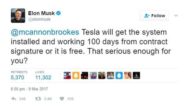
In March Musk made his pledge on Twitter the he could deliver the battery within 100 days of signing the contract or it would be delivered free. Jay Weatherill, the South Australia state’s premier, confirmed the deal, which now is a part of the government’s A$550m energy plan.

“I’m thrilled with the selection of Neoen and Tesla, whose experience and world leadership in energy security and renewables will help South Australia take charge of its energy future,” Weatherill said.

On a related theme, read about the South Africa Power Crisis here.

Read More »
Sun tax, Spain, Off-grid, solar panels, tax, grid
Solar

Spain’s Sun Tax to be axed

In October 2015, Spain’s Council of Ministers approved a controversial tax on those using electricity produced by their own solar installations. However, a new government says solar panel owners could soon see the back of the so called sun tax.

What is the sun tax?

This legislation causes those with self-consumptive photovoltaic systems to pay the same grid fees as those without solar panels. This covers the power contracted from an electricity company. But they also have to pay a second “sun tax” which means solar panel owners pay for the electricity they generate and use from their PV systems, even though it doesn’t come into contact with the grid.

There are other facets of the legislation which also caused more outrage. Photovoltaic systems up to 100 kW are not able to sell any excess electricity they produce. Instead, they must “donate” the extra to the grid free of charge. Systems over 100 kW must register if they wish to sell the extra electricity. Community ownership of PV systems, of all sizes, under this legislation is prohibited. Not only this, but the legislation is retroactive; meaning installations prior to the introduction of the tax must comply. If the conditions are not met, then the PV system owners are subject to a penalty fee of up to €60 million ($64 million). To put this in perspective, this is twice the penalty of a radioactive leak from a nuclear plant. Unsurprisingly, this caused outrage.

Exceptions to the tax

There are some circumstances where the tax does not apply. Fear not off-gridders, this tax is only for those connected to the grid. If you run an off-grid system then no grid tax needs to be paid at all. Installations smaller than 10 kW are also exempt from paying the second sun tax. The Canary Islands and the cities of Ceuta and Melilla (Spanish territories in Africa) are also exempt from the second tax. Mallorca and Menorca pay the second sun tax at a reduced rate.

The Spanish government defended the legislation by saying the fees contribute to overall grid system costs. However, the Spanish Photovoltaic Union (UNEF) pointed out how uneconomic the new law was. Their spokesperson stated, “Each kWh imported from the grid by a self-consumer will pay double the tolls compared to a kWh imported from the gird by another consumer.”

Change on the horizon

The current legislation is an unnecessary burden placed upon solar consumers who want to be more economical and environmentally friendly. This has been recognized by opposing political parties and other unions and consumers. The political party which initially brought in the sun tax is now a minority. Therefore, there is now the opportunity for all opposing parties to remove this expensive and impractical legislation.

In January 2017 a law proposal was registered in congress, beginning the process of the sun tax removal. The urgent changes …

Read More »
Tesla, Solar, Batteries, Powerwall
Energy

Powerwall 2 takes homes off-grid

Batteries to store the excess energy that solar panels capture have advanced only slowly in the past 20 years …until now. Tesla has come up with a new approach it claims is faster cheaper and better – the Powerwall 2.

This wall or floor mounted battery pack has twice the energy of Tesla’s first generation battery, with 13.5kWh of storage. Each pack has up to a 7kWh power output, with a continuous 5kWh output on average. A liquid thermal control (coolant) system helps to regulate the internal temperature of the battery, maximising its performance. Whilst the water resistant, dust proof casing allows for outdoor or indoor installation.Up to nine of these 120kg units can be stacked together to power homes of various sizes.

Alongside these features, the Powerwall 2 has an inbuilt inverter. Not only does this save on space, it means there’s little chance of error as it doesn’t need to be hooked up to an inverter from a third party. Other battery makers such as LG Chem have to use inverters produced by other companies, making Tesla unique in this feature.

One 755mm x 1150 mm x 115 mm 14kWh Powerwall 2 battery costs $5,500 (£5,400) with installation costs starting at $1,500 (£950). Each pack comes with a 10 year warranty and the first installations are due to begin in early 2017.

Tesla is also in the process of bringing out their range of solar tiles. These come in four styles, from Tuscan to slate glass. They are opaque from the street but transparent from above, allowing the suns rays to penetrate the tile and the solar panels within to capture energy.

The use of a Powerwall 2 pack with solar panels enables homes to become self-sufficient in providing their own energy. Tesla CEO Elon Musk has a clear vision of an affordable, integrated power generation and storage system which can be rolled out across whole neighbourhoods, allowing whole streets and communities to be off-grid.

Prices of the new Tesla solar tile range are yet to be released.…

Read More »
Solar panels, smart battery, electricity, Yorkshire, grid,
Energy

Free Home Batteries Trial Increases Grid Capacity

A small community in South Yorkshire, UK has been targeted for a trial involving solar power and smart batteries. Forty homes in near Barnsley are having smart batteries installed at the end of January. Moixa, Northern Powergrid and Energise Barnsley are all collaborating on the £250 million ($308 million) project.

Moixa Batteries USB port

The Moixa batteries are smaller than a boiler (50cm x 30cm x 20cm), wall mounted with a 20 year lifespan. They even have a USB port so phones and other devices can be charged direct from the battery. Normally costing above £2,500 ($3,000), the residents received their batteries free of charge, with distributor Northern Electric footing the bill. 30 of the homes had solar panels, allowing them to be further independent of the grid. The batteries have good saving potential, giving the residents another reason to be positive about the trial.

The batteries allow residents to use the excess energy their solar panels generate during the day, at night time. They store the energy produced instead of transmitting it to the grid. This will relieve pressure put on the electricity network during times of high output but low demand. It is this reason that prevented the energy company Energise Barnsley placing more homes with solar onto the trial. Without expensive upgrades it is infrastructure which is limiting the number of homes that can have solar power. A project in Carmarthenshire, Wales, faced a similar problem, with only 37% of homes being able to connect with solar energy.

Lower Carbon

As outlined in Moixa’s press release, CEO Simon Daniel stated, “Batteries will allow the electricity system to support much higher levels of low carbon renewable power and increase UK energy independence.”

Linking the batteries in a virtual power plant system allows Moixa to make the wider grid more efficient, causing less need for back up from non-renewable sources. If rolled out across the country, millions could be saved by reducing the peak solar output onto the electricity network.

If the trial is successful, batteries could hold the key to UK energy independence.…

Read More »
ethnography of candlelight
Off-Grid 101

Pools of light and off-grid comfort

ethnography of candlelightThis site is dedicated to showing how you can live off the grid in comfort and style without costing the earth. Lighting is fairly crucial part of that. Being able to snap on the light when you come home is just as important to off-gridders as to those who are grid-connected.

Light is expensive, energy-hungry, and vital to our happiness – especially at this time of year. And there is a large degree of unanimity amongst off-gridders about what makes good lighting and how to achieve it.

When you live off-grid, electric lighting is not something you can take for granted. The means for controlling natural and artificial light and thus achieving visual comfort are not as well-established in the Unplugged community. But the off-grid aesthetic is now spreading to the plugged-in community.

So how do off-gridders light their homes to maximise the gain and minimise the cost?…

Read More »