

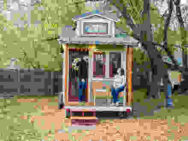
American architect and designer Meg Stevens was “immediately hooked” on tiny houses when she discovered them five years ago. She set a plan in motion to design and build her own tiny house – which was realized last year when she moved into The Lucky Linden, a tiny house RV measuring about 170 square feet.
Meg grew up in Michigan in a neighborhood under construction. Spending her spare time helping her dad with building projects, her interest in architecture, design and building was piqued at an early age. When she became interested in tiny houses in 2013, she purchased a ticket to a workshop at Tumbleweed Tiny House Company, an organisation focused on designing tiny house RVs, in order to learn more about the process. She ended up being hired as an architect, and her Lucky Linden RV design is one she created for the company – with a few changes made to suit her (and her husband Dan’s) personal living style.
“We decided to build a tiny house about five years ago, and immediately started planning (and saving up money),” Meg said. “We didn’t want to go into debt for the house, so I would work on the build as we had the funds, and put it into storage while saving up for the next phase. It took three years to build this way, and it was in storage for stretches of time from six months to over a year.”
“While we were building, we gradually downsized until we were living in a 330 sq ft studio apartment,” she said. “The apartment was just a bit over double the size of the tiny house, so when we finally finished the build and moved in to the tiny house it wasn’t much of an adjustment at all. We love it!”
Tiny houses can be anything smaller than the normal for family size, according to Meg. A four-person family living in a 600 sq ft house is tiny, because there is only 250 sq ft per person. But conventionally – at least in terms of the growing Tiny House Movement across the US – a tiny house is between 100 and 400 sq ft. And the majority of them are built for off-grid living.
Meg, a prominent member of the Tiny House Movement – a community of like-minded individuals across the US advocating tiny houses as energy efficient living spaces – says the American tiny house community has experienced “rapid, almost exponential growth” in the last four years, owing to environmental concerns, financial issues as the cost of living rises, and the desire for more time and freedom.
“Designing especially is more difficult in a small space, but it’s rewarding. Efficiency is everything, and really considering ‘needs’ vs ‘wants’ vs ‘nice-to-haves,’” Meg said.
“Tiny houses are more energy efficient just because of their size, but also I think the general …
American families have been going off-grid for more than forty years, but for most it’s a gradual process, involving a lot of learning by trial and error. In a recent article published in Reason, J.D Tuccille wrote about how his experience going “semi-off-grid” in 2008 led him to reconsider his attachment to the mains, and begin a journey towards self-reliance that is still ongoing today.
Dipping into off-grid waters
In 2008 a power failure lasted a week at J.D’s former home in remote Arizona. While he had his own well, it was controlled by a pump that required electricity, and the surface of the water was too low to dip some out by hand. Then there was the issue of modern plumbing without electricity, and the requirements of coffee pots to consider. However, outages were common – so J.D had come prepared. He and his wife Wendy Wendy had stored water, cut firewood, and fueled up the camping stove and lanterns. They remained hydrated, warm and fed through that and every other experience with the electric grid’s unreliability.
“All in all, it was a bit Little House on the Prairie for our tastes, though with a better wine selection – but ultimately more of an inconvenience than a disaster,” he wrote. “But tolerance for inconvenience can decline with the years.”
When they moved to a new house in the foothills, Wendy had a strict requirement – a climate-controlled environment in the house at all times. This required some research into the best off-grid power systems to use for the climate, so J.D had to get serious.
“This being Arizona, where everything bakes for much of the year under the fireball in the sky, my first thought was solar,” J.D writes. “But I quickly discovered that all of those panels adorning people’s roofs were nothing more than expensive shingles during a power outage. Most solar installations are designed to feed the grid, not keep you independent of it. I priced adding batteries to the mix to gain some autonomy, but they more than doubled the cost. And batteries couldn’t handle the power demands of an air conditioner anyway. So we settled, if that’s the right word, for a 22 kW standby generator, which can handle the well pump and keep the air conditioning running.”
He said they were “especially pleased” with the decision when the European Union completed a coordinated cyber-attack simulation and found it leading to a “very dark scenario,” including crashed power grids.
J.D also beefed up the water storage capabilities at the house with rain barrels hooked to the gutters, which are conveniently located near the garden where he now grows tomatoes, olive and fig trees.
“Wendy and I have stumbled down our path incrementally over the years out of a combination of necessity and curiosity,” he writes. “We also keep tweaking our set-up. In addition …
Catch our video visiting one of America’s greatest living novelists as she does her daily chores the Maine backwoods?
She just doesn’t trust the system – nor want any part of it.
Carolyn searched for her piece of heaven together with her husband. They are both people who lost faith in the system, as it failed them.
She talks movingly about the death of her baby son when she did not have the money for medicare bills.
Carolyn also has a deep sense of pain for the slaves that were brought over many years ago. She wants to live a more natural and earthy life so that she can find peace within.…