


Communities
UK preppers come out of hiding
Prepping involves having a bug-out location, a bug-out vehicle, plenty of canned food, weapons, and bushcraft skills…
Prepping involves having a bug-out location, a bug-out vehicle, plenty of canned food, weapons, and bushcraft skills…
Black Friday, it’s something that some of us look forward to, for the rest of us it’s something to avoid like the plague, the consumerism, and sometimes the insanity. I can be counted in the latter group, I suppose it’s because of too many years working in retail and malls, being on the other side of the insanity that seems to possess people after eating all of that Turkey, dressing and pumpkin pie.…

I just spent the day, actually the last two days, working on and working up to one of my favorite holidays, a holiday we celebrate in the USA during November, Thanksgiving. This is when we go out and buy an appropriately sized turkey, lots of trimmings to go with it, cook and eat with family and friends, getting as stuffed as that turkey was and feel happy. This is our 4th Thanksgiving living off-grid, we moved out here in Dec ’07, we had spent the previous Thanksgiving with our family, saying goodbye and farewell.…
There are many ways of living off the grid, for some it means buying up some land, putting up a small cabin with solar panels and such, growing a garden, hunting and living as close to the land as possible. For others it means something entirely different. There is a whole culture around van living, ie living in a vehicle, usually a van or camper, not setting roots in any one place, being free to move around as they please.…
So, you are sitting in your climate controlled home, with lights, refrigerators, freezers, air conditioners, heaters, fans, TVs, computers, home theater systems, running water, sanitary systems and all the other things that go along with modern life. Now, go into your garage, or whatever room where your power panel resides and shut off the main switch. Now walk through your home, look around at all the electronic appliances and gadgets that are now nothing more than lumps of worthless metal and electronics. Now imagine how you would live if none of these things came back on? What if this was not just your home but your neighborhood? City? Country? World? Sounds drastic doesn’t it? Could you live, could you survive without all of these electronics being powered from the grid?…

A first British showing for the acclaimed series A Natural Order by Lucas Foglia, the young American documentary photogapher who spent five years in Tennessee, Virginia, Kentucky, North Carolina and Georgia among people who live “off the grid” in the American backwoods.
Lucas Foglia grew up on a farm on Long Island just 30 miles from Manhattan. His parents were part of the post 1960’s “back to the land movement”. Much of the area surrounding the family home became increasingly urbanised, but his parents continued to strive for self-sufficiency. …
I am so saddened by the aftermath of the big storm that hit the north east part of the USA. This is so apropos to what I have been writing about lately, namely prepping on a budget. I have to wonder how many people were really prepared for this storm, how many had food, water, fuel, batteries and such……
Water. It’s necessary for life, and it’s pretty handy to have around. Drinking, cooking and cleaning, you need water. This will be a 2 part article, the first part discussing how we have water living off-grid (ie with no city water), the second part will discuss how to make sure you have water if you are living in town but services get interrupted, that will be also part of the “Prepping on a Budget” series.…
Now that you have decided to start putting aside some food, you might be thinking “Where am I going to keep all of this food and other stuff?” Hopefully you have lots of extra space, an extra bedroom, or a big kitchen with a pantry and lots of cabinets… or if you are like many of us, space is at a premium and you will have to be creative about how and where you store your preps.…

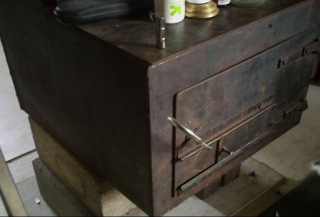
Fall is here, that means winter is just around the proverbial corner. For most of us, that means having to keep our homes warm in some manner. For us, that means using our wood burning stove that PB designed and built himself when we lived back in the city and had access to a friend’s metal shop. It’s all made out of 3/16 plate steel with schedule 40 steel pipe for the flue (we aren’t afraid of flue fires). He poured about an inch and a half of refractory cement in the bottom. It serves double duty when I want to cook something on top of it, it makes great tortillas and pizza. The whole thing weighs in at around 200 pounds, I am still amazed at the fact that PB managed to get it inside the skycastle without any help, up to the second floor (our living space) that didn’t have steps yet, we used a ladder to get in and out.…
While scouring the internet looking for ways to be more self sufficient, I ran across a great (new to me) author, her name is Susan Gregersen. As I dug deeper about Susan, one of the things that really interested me was her very down to earth nature, she writes using everyday language, nothing pretentious here. If you have lots of money to prep with, then this book isn’t for you, but if you are on a tight to impossible budget, like most of us are, then this will be a great book for you.…
With prices on everything going up and our earnings going down, many of us are living on the edge, some of us are only one paycheck away from being homeless. Right now, food and supplies for everyday living is readily available, you can walk into any store and find the shelves stocked with food. But you must realize those shelves can be empty in just a matter of hours in any kind of major emergency. These types of emergencies can be on a global scale, solar flares, asteroid or comets impacting the earth, to regional problems such as hurricanes, floods, wildfires, to very local problems, such as a car hitting a power pole knocking out the power for your entire neighborhood… even down to a very personal crisis, like losing your job, being injured and not being able to work, having an unexpected bill. What can you do to help ensure that you will survive?
As I mentioned, grocery stores have stocks of food, right now, but that could change in a heartbeat. It used to be that grocery stores had larger warehouse areas in the back of the store, they received fewer but larger shipments. Now, most stores have at best, a 3 day supply of food in the store, including the stock room in back. They receive multiple shipments a week, but ultimately receive less stocks of food from each one. If anything were to happen to the transportation of these foods, trucks, or trains, or airplanes or ships, then your grocery store will run out of food within about 3 days, that’s IF there isn’t a panic run on food, then you have hours at best. If something happened and you could not leave your home, starting right now, today, how long would it be before you started running out of food? How long before you would be in real trouble? A few days? A week? A couple of weeks? A month?
Today I’ll talk about how to prep in the area of food, even if you are on the tightest of budgets. If you say to me that you cannot afford to put back extra food for emergencies, I will tell you that is precisely WHY you need to do it. If you have extra food, even as little as an extra 2 weeks to a month’s worth of food, then in a financial emergency, such as an unexpected bill, or job loss, you will not have to choose between buying groceries and paying your rent or mortgage.
First you need to decide how much extra you can spend, if you do not have a budget written down, it’s time to do it and see just where your money goes, you might be surprised as to how much waste happens a few dollars here and a few dollars there. I know there are ways you can …