

Today is the day the UK’s “Sovereign AI” future, and its “Net Zero” transition, both collapsed under the weight of their own administrative fiction. Within hours of each other, two announcements laid bare the delusions of British infrastructure planners.
OpenAI, the golden child of Silicon Valley, announced it has frozen its flagship “Stargate UK” data centre project in the North East. Simultaneously, Drax, the government’s pet biomass behemoth, quietly admitted that its carbon-capture fantasy—the mechanism upon which the UK Net Zero calculations strategy rests—is dead in the water.
This is not a coincidence. It is a symmetrical disaster; the definitive proof of policy collapse.
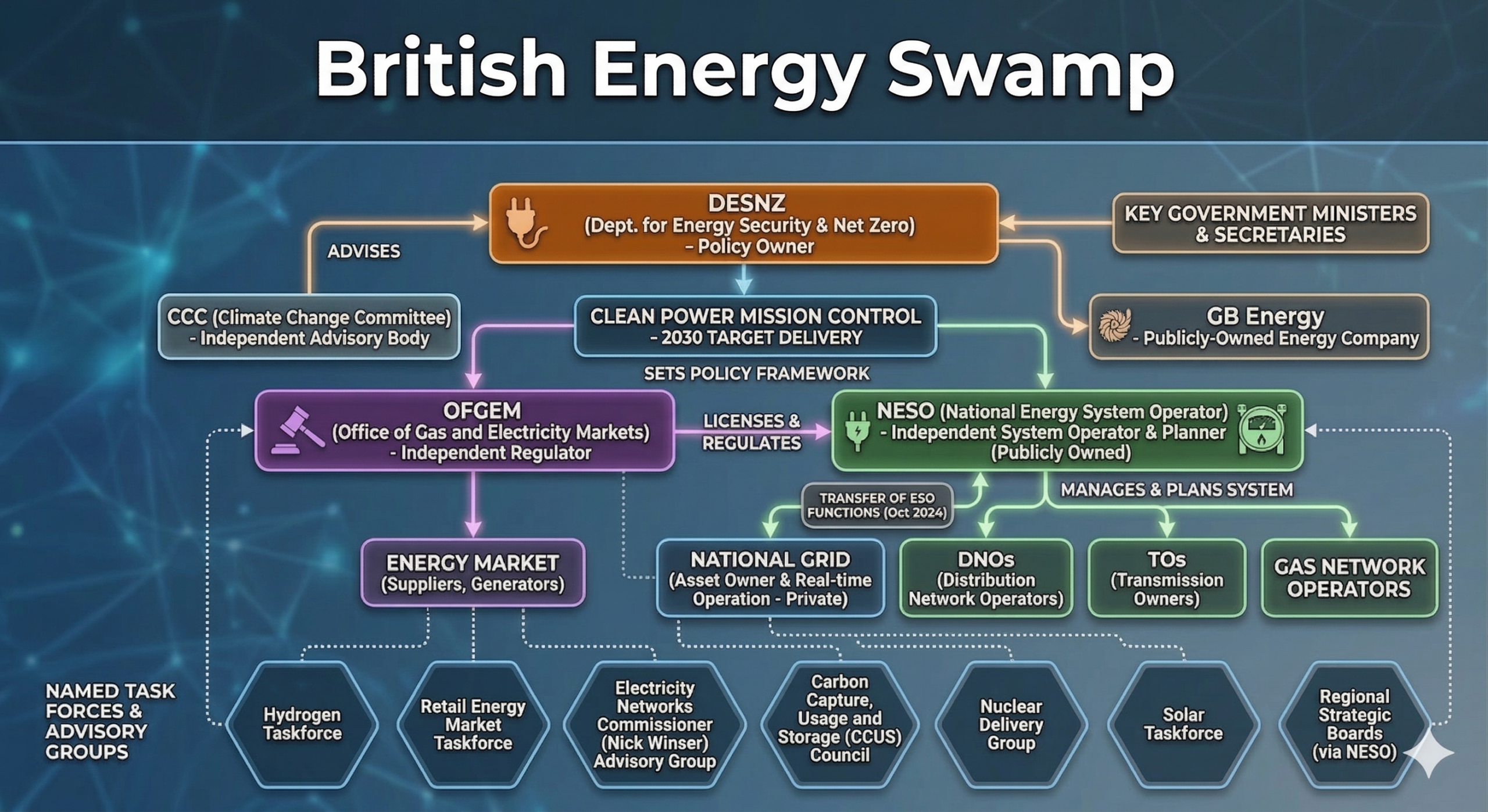
To understand how UK PLC arrived at this dead-end, I need to explain the anatomy of the UK Energy industry. At the apex is a vast bureaucracy called Ofgem, wielding 10,000 pages of energy market rules that only a handful of lawyers understand. Next in line is Great British Energy (GBE), established by Act of Parliament in 2025, with a stated budget of £8 billion to spend on local and clean energy. GBE spent its first year writing reports to itself, instead of actually getting out there and financing energy projects for the country.
OFGEM and GBE report to Energy Secretary Ed Miliband, who helped create the current system when he was energy secretary under Gordon Brown. Now he is in full control, and the responsibility for its failings rest with him.
Take the Stargate fiasco. For months, Starmer, Miliband, and their Sovereign AI cheerleaders strutted around the global stage like they had personally invented the silicon chip. They heralded September’s tech deals with US giants as a “decisive step” toward the UK becoming a world leader in artificial intelligence. They courted Sam Altman. They envisioned a temple to high-performance computing in the North East that would cement Britain’s place in the digital century.
Then reality intervened. OpenAI looked past the warm white wine and the Downing Street canapés to examine the actual spreadsheet. They saw a country with the highest industrial energy prices in the G7. They saw a planning system that takes half a decade to approve a transmission cable. They saw a grid that charges you a premium for the privilege of being constrained. Worse, it is a ‘ghost grid’ where the taxpayer actively pays wind farms millions of pounds to turn off (constraint payments) simply because the transmission cables are too weak to carry the electricity to where it is actually needed. Data centres do not run on political rhetoric; they require massive, cheap, reliable baseload power. The UK offers eye-wateringly expensive, highly intermittent power, regulated by lawyers and civil servants who have never been required to make a profit.
The hypocrisy is breathtaking. Miliband stands at the dispatch box, claiming that local energy will be delivered “At pace” and lecturing the nation on the necessity of “Green Growth,” while overseeing an energy landscape so toxic that it drives the industries of the future to Finland, Texas, and the UAE.
You cannot have a “Sovereign AI” strategy if you do not have a sovereign energy strategy. The Stargate exit is the market telling the government that their mathematical models are fraudulent. In the ultimate humiliation, we invited the future to set up shop in the UK, and the future politely declined because we couldn’t guarantee to keep the lights on.
If Stargate is a tragedy of the future, the Drax collapse is a comedy of the present. For years, energy lawyers in DESNZ have pinned the “Net” in “Net Zero” on a single, absurd bet. The Drax power station in Yorkshire produces about five percent of the country’s overall power by burning millions of tons of wood pellets imported from North American forests. This practice is considered “green” only on a civil servant’s spreadsheet, justified by the bureaucratic fiction that planting new trees decades from now offsets the immediate, massive release of carbon today.
The Faustian pact the government made with Drax was simple: we will keep paying you billions in subsidies to burn wood, provided you eventually bolt on vast carbon capture facilities (BECCS) to bury the emissions under the North Sea. The problem is that BECCS at this scale is a largely untested, financially ruinous technology. It was a fantasy from the start.
Jeremy Pocklington, the top official at DESNZ, called it the “opportunity to provide the ‘net’ in ‘net zero’ at scale.” But Alan Whitehead, Miliband’s own minister, wrote reports warning that continued government backing for biomass was only sensible if the carbon capture was actually installed. The warnings were clear: lock Drax into a binding agreement. Force them to deliver.
The blame for the Drax fiasco rests squarely at the door of Ofgem. Instead of creating a streamlined, functional framework that forced Drax to deliver on its carbon-capture promises, Ofgem suffocated the project in regulatory uncertainty. They created a labyrinthine environment where it was easier and more profitable for Drax to walk away, keep burning imported wood pellets, and pocket the subsidies. Ofgem doesn’t manage the grid; it litigates it to death. AI could do a better job than OFGEM.
On the other side of this dysfunctional coin is Great British Energy, which is entirely culpable for the Stargate collapse. GBE was sold to the public as the state vehicle that would finally use its £8.3 billion “money muscle” to “crowd in” the infrastructure we desperately need. You would expect a new state energy company to ram through at least three to six rapid “proof of build” projects—getting shovels in the ground to show the world we can deliver actual baseload power. Instead, GBE has spent its time releasing industry briefings, hyping up seabed leasing partnerships, and handing out grants for solar panels on library roofs. While OpenAI was desperately looking for a place to plug in the future of computing, GBE failed to back a single megawatt of the physical, dispatchable power required to keep them in the UK. Meanwhile, every household in the country is paying an average of £1,700 for their energy—money which we could divert to building our own small-scale, local power that actually works.
This is the essence of the “Green Growth” agenda. It is the greatest gaslighting campaign in recent history. It is neither green, nor does it produce growth. We are burning foreign forests to keep the grid afloat because our leaders are too terrified of real energy independence, be it nuclear or extensive local generation. And it produces no growth, as evidenced by OpenAI packing its bags and the manufacturing sector fleeing our shores to escape the growth tax of extortionate electricity bills.
The simultaneous collapse of Stargate and BECCS is not just a bad news day. It is a paradigm shift. It is the final, irrefutable proof of a hard truth that the community energy sector has known for a decade: nobody is coming to save you.
The era of “Big Infrastructure” delivered by “Big Government” and “Big Tech” is officially over. The state is broke, buried under a mountain of debt, and managed by individuals who couldn’t organise a blackout in a basement. The big energy companies will not save us; they are subsidy-harvesting machines that will not move a muscle unless the taxpayer de-risks every penny of their investment. And the tech titans certainly will not save us; capital is mobile, and they owe no loyalty to our delusions of digital sovereignty. If the UK is too expensive, they leave. While the UK ties itself in 10,000 pages of knots, Texas and the UAE are pouring concrete and laying cables. We are not just losing a single data centre; we are actively exporting the 21st century to countries that actually build things.
The only logical, sane response to this policy collapse is radical localism. If you want light, heat, and compute in 2026 and beyond, you have to accept that the government is not gong to do it for you and nor will Big Energy. Your community will need to build it, own it, and manage it yourselves.
We need a massive proliferation of community microgrids, local power islands, and off-grid networks that exist entirely outside the reach of Ofgem’s 10,000 pages of red tape and the grid’s extortionate charges.
We must fund it ourselves—using that £1,700 a year we are currently bleeding to the energy cartels— funding through community bonds, local cooperatives, and private initiative. That is the only way to retain ownership (and the control that comes with it); the only shield against the incompetence of the state. When a community owns its own generation and storage, it becomes immune to the “regulatory uncertainty” that just killed Stargate. It becomes immune to the accounting frauds that just killed Drax’s BECCS. It stops being a hostage to the transmission constraints of a grid built for the 1950s.
The strategy of waiting for Whitehall to deliver cheap, clean, reliable power has been exposed as a fool’s errand. The Stargate is closed, and the biomass fires are burning out. Great British Energy will continue to write reports, and Ofgem will continue to draft rules. Let them. The future of British energy will not be dictated by lawyers in London; it will be built by pragmatic communities at the edge of the network, paying for it themselves, and finally taking the power back into their own hands.