

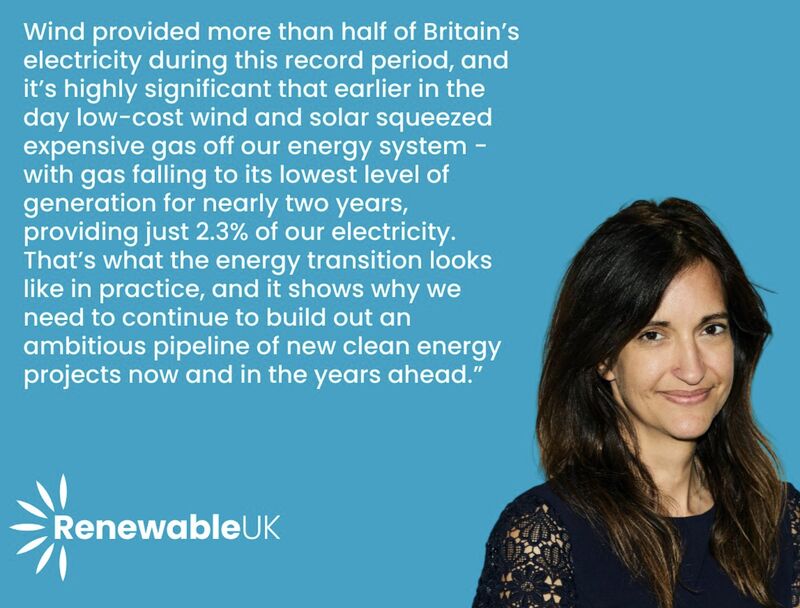
Events like this one matter. Bringing together energy system operators, network owners, government officials, investors and developers in one room — focused on the shared challenge of making Britain’s energy cheaper, cleaner and more secure — is genuinely valuable. RenewableUK’s Flexibility and Grid conference deserves credit for convening it.
The opening remarks from Tara Singh, RenewableUK’s new CEO, revealed some of the limitations that hold this sector back. “Renewables can only deliver (their) promise at scale, ” she said, “if the grid can connect and move power where it’s needed, and if the system can balance supply and demand every hour of the day.”
Singh was appointed CEO in January 2026 and started in post on 23 February, meaning today was her first major appearance in the role. She is not an engineer, a developer or an operator. She is a communications and lobbying professional, Energy and Environment Adviser to David Cameron at No.10 Downing Street between 2013 and 2015, then global lead for integrated power policy and advocacy at Shell’s Renewable and Energy Solutions division, and most recently Managing Director for Public Affairs at Burson, the global lobbying and PR agency. That background matters, because it is the lens through which today’s opening was written.
Her introduction opened promisingly. “This year’s conference comes at a pivotal moment for the UK energy system,” she said. “With heightened geopolitical uncertainty….Energy security and decarbonisation now go hand in hand: the more we can run on domestic renewables, the less we’re exposed to imported fossil-fuel shocks.” True, as far as it goes. But then came the telling assumption that the grid must “connect and move power where it’s needed.”
This is the same grid where, as one speaker confirmed today, the attempt to rationalise the grid queue has yet to yield benefits. Despite the best efforts of every government energy agency from Mission Control to Great British Energy to NESO – there is still a 5-10 year delay for new energy connecting to the grid and new supplies from the grid. There are still billions in unpredictable costs thanks to the government’s “CfD” deal with private companies – one which Reform has given notice it would cancel if elected.
In all this the grid is treated as the given. The solution, the frame, the only possible architecture. But is there another way? Can we now start to supplement grid energy with other forms of supply, and allow them to compete directly with the grid when its advantageous to do so?
Is it possible that the grid’s own cost structure and connection failures are themselves part of the problem and that regulatory changes begun in January 2026 may eventually allow local aggregated generation to supply customers directly without using the grid at all? That does not appear anywhere in yesterday’s script.
Singh promised delegates “a day that’s focused on delivery — with honest discussion on the trade-offs and real-world constraints …” That is the right aspiration. But honest discussion of trade-offs requires naming what is not in the room. The distributed energy revolution that the new Class A small-scale permit framework has unlocked; the 25,000 households that the government’s £86.5 million investment in ITM Power could have connected to local clean generation; the consumers paying 34p per unit — including standing charges — when local exempt supply can deliver at 15p: none of that featured.
It is worth noting that Singh made headlines in March 2026 — barely a month into the job — by publicly backing continued North Sea oil and gas drilling. That must have been an uncomfortable decision, but she was brave to say it, and it shows she is committed to truth wherever that may take her.
Now let’s see if she will come out and say that the grid is an extraordinary piece of 20th century technology that is not fit for purpose in the 21st century. Without that, we are left with managed consensus — as you would expect from a corporate-Whitehall-lobbying insider. Nothing wrong with that, except it is consensus thinking that has brought the UK to the stage where we have some of the world’s most expensive energy and no plan B.
I, for one, don’t believe either the government or the energy industry know how to get us out of the mess we are in.
And it is frustrating when so many brilliant brains are in the room, that the one solution we haven’t tried yet – rolling out cheaper, faster, greener micropower exactly where it is needed – is sitting on the shelf like an unopened Amazon package.
#RUKFG26